Google Just Changed How You Get Found. What It Means for Direct Bookings - Takeaways from Our Webinar

By Farzana
Google has just rolled out its most significant overhaul of Search in a generation - and if you run a hotel, resort, holiday park or tour business, it changes how your next guest finds you. In our recent ‘Google Just Changed How You Get Found. What Now?’ webinar, we unpacked what's new, what it means for direct bookings, and what to do over the next 90 days. Here are the biggest takeaways.
Watch the full webinar (45 minutes) below
Search is now AI-first
At Google I/O 2026, Google announced that AI Mode is becoming the new search experience - intelligent, conversational, and built to compete with ChatGPT and Perplexity. Instead of typing "best family resorts in Cairns", travellers can now ask: "Plan a 5-night family holiday in Cairns in July under $4K with a heated pool and activities for a 7-year-old." Google responds with recommendations, comparisons, itineraries and booking options - all before anyone clicks through to a website.
Google Search is also becoming agentic, moving from answering questions to performing tasks: researching destinations, comparing accommodation, and building itineraries. With partnerships already announced with Booking.com and Expedia, agentic travel bookings are on the way.
Travellers have already changed how they search
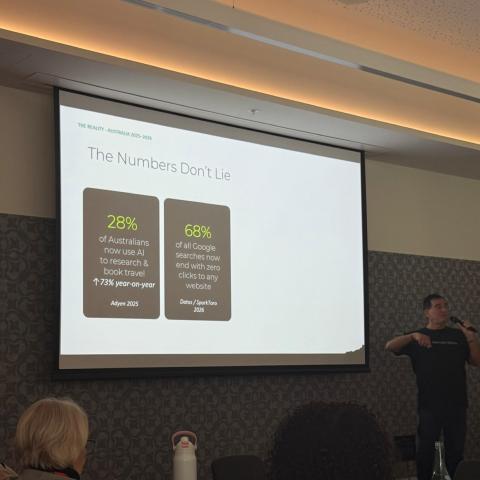
The shift isn't coming - it's here. AI Overviews now appear on more than 60% of travel queries, absorbing clicks before users ever reach your site. ChatGPT has become the second-largest search engine for travel research, recommending specific properties by name. Google AI Mode has surpassed one billion users, and Perplexity is growing fast among high-income travellers. The upshot: your website may no longer be the destination - and clicks are no longer the benchmark for visibility.
Why direct bookings still matter - the AI trust gap
Here's the good news. According to Expedia's AI Trust Gap report, travellers trust AI to suggest, not decide. While 53% are comfortable letting AI suggest options, 66% wouldn't trust AI to book anything on their behalf. Travellers still want to know who fixes it when something goes wrong, and what flexibility they have when plans change - and booking direct answers those questions in a way AI and OTAs can't. But there's a catch - less visibility means fewer direct bookings, which means higher distribution costs. Staying visible in AI results is now a revenue protection strategy.
The new visibility framework: SEO + GEO
Traditional SEO is still essential, but it now works alongside a new discipline: GEO - Generative Engine Optimisation, the practice of making your property visible and citable to AI engines. In the webinar we walked through five GEO actions, from answer-first content and schema markup to review optimisation - because detailed, keyword-rich reviews mentioning your location, room type and amenities are effectively AI training data.
We also covered why quality properties go missing from AI results - no schema markup, generic copy, thin review profiles, no press coverage, slow mobile sites - and why your website needs to work as a booking engine, not a brochure: price and availability visible early, trust signals above the fold, and mobile pages loading in under three seconds.
Paid search is your safety net
Google has rebuilt its commercial layer too, and the platform shifts directly affect travel advertisers. Demand Gen is replacing Display, putting visually rich campaigns in front of travellers earlier in their planning journey across YouTube, Discover, Gmail and Maps. Dynamic Search Ads are upgrading to AI Max, and Performance Max now includes AI Mode placements - meaning your asset quality and feed completeness determine whether your ads appear inside AI trip-planning results. In short: your feed is your ad.
New AI ad formats built for travel are arriving as well, including conversational ads where Gemini tailors creative to a traveller's exact question, and Direct Travel Offers that surface deals inside Google's AI trip-planning with native checkout. One critical warning: if your rates aren't in Google's travel feeds (Google Hotel Centre for accommodation, Things to Do for tours and attractions), Google AI will show your OTA rate instead - and the OTA gets the booking.
The strategy: treat paid as your safety net while organic clicks decline. Use Search Console to find where AI answers are absorbing your clicks, run paid campaigns on those exact terms, and feed Performance Max your best assets so Google can place you inside AI Mode.
Your 90-day action plan
The webinar closed with a practical roadmap: quick wins in the first 30 days (schema, reviews, feed connections), structural improvements through day 60, and authority-building from days 61 to 90 - including a content cluster of interlinked destination pages, retargeting for AI-influenced visitors, and monthly AI visibility tracking.